DEBA Deterministic Emergence by Actualization
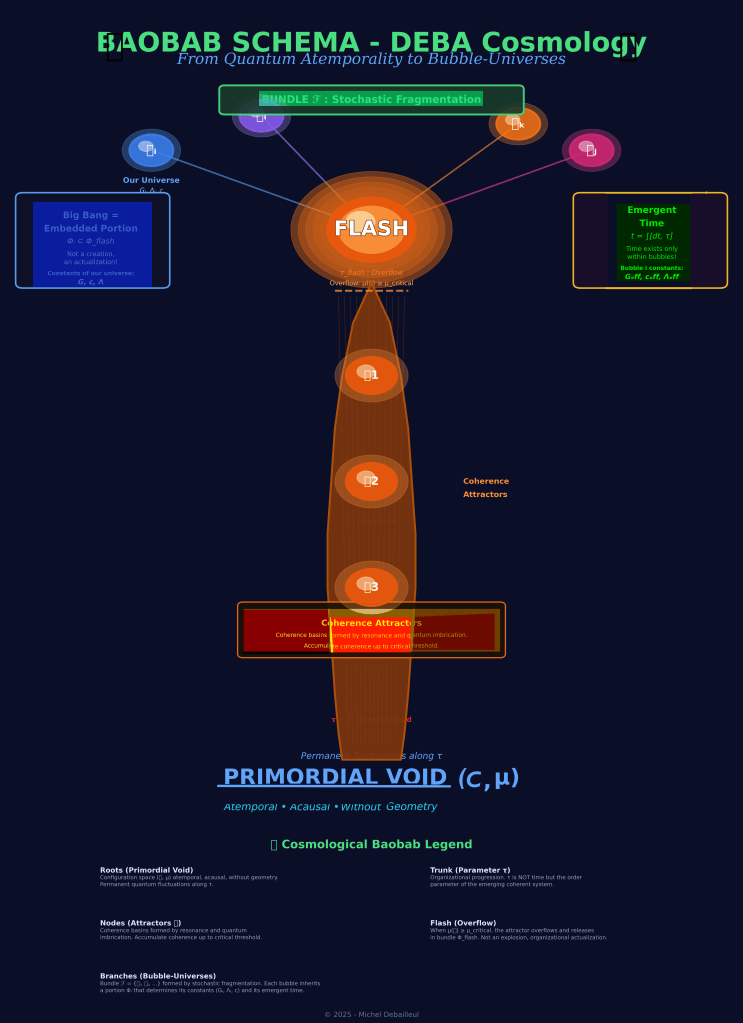
Every cosmological theory requires a starting point. In the standard model, that starting point is a spacetime singularity — the Big Bang — within a spacetime already endowed with a metric and causality.
DEBA proposes a more radical break: before any physics, there is no space, no time, no geometry, no causality. There exists only
an abstract, purely formal substrate, which we call the Primordial Void.
This Void is not an ordinary physical vacuum (no vacuum energy, no quantum fluctuations in the usual sense), but a space of possible configurations endowed with a statistical measure.
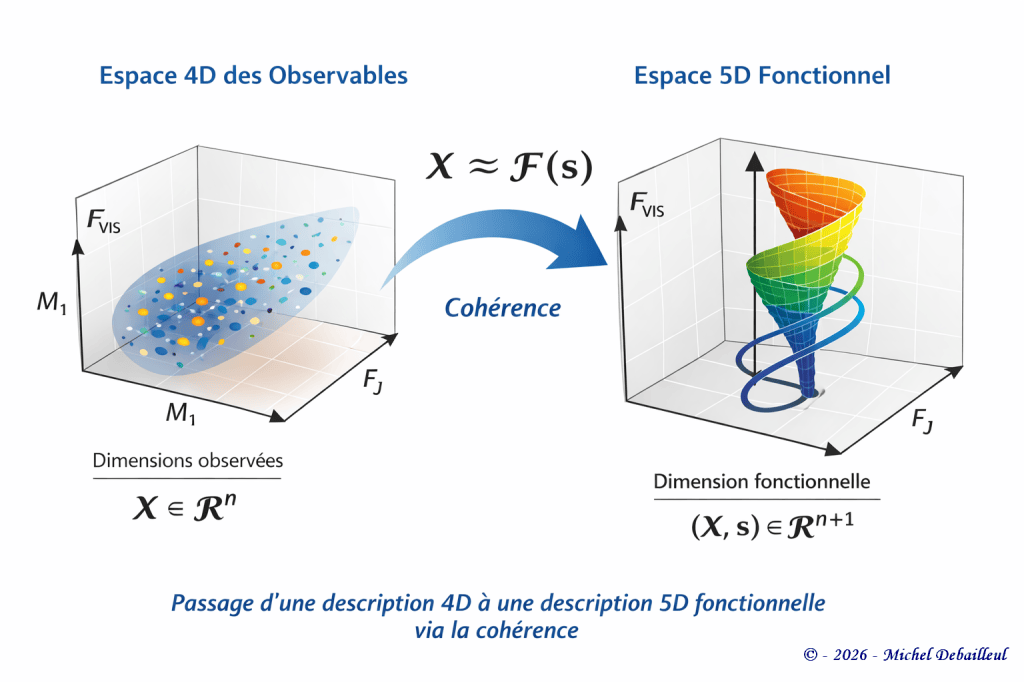
Physics will emerge later, through coherence condensation.
https://figshare.com/authors/Michel_DEBAILLEUL/22940029
Published September 15, 2026 | Version V_2.0
https://github.com/Orion4622/moon-and-water
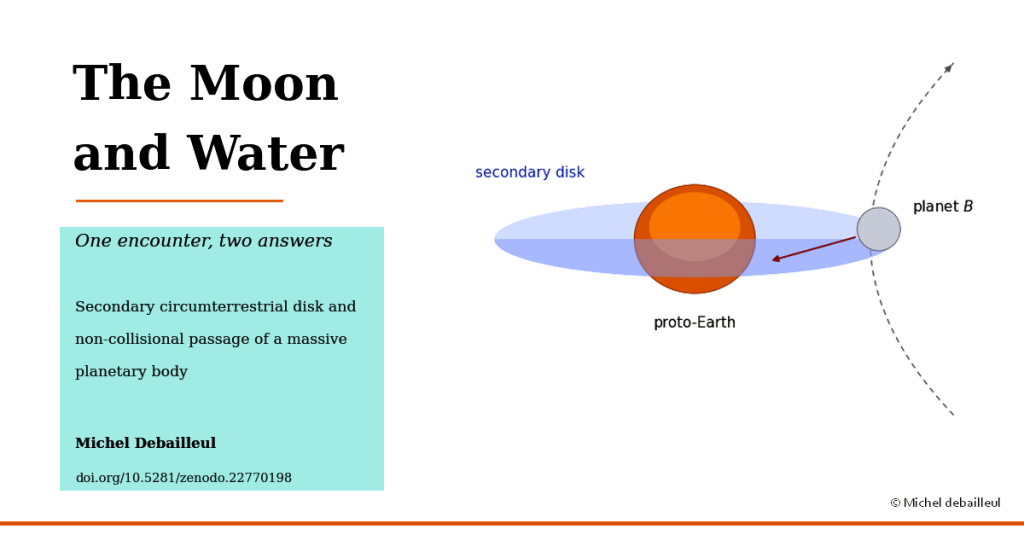
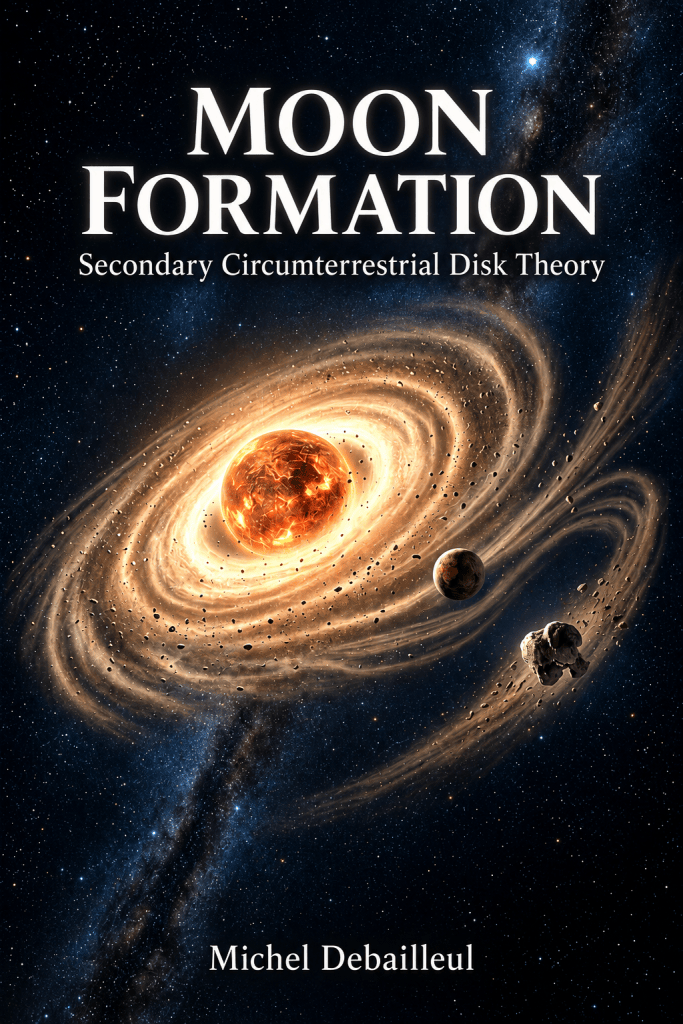
The Moon and Water – Secondary Circumterrestrial Disk and Non-Collisional Passage of a Massive Planetary Body
This monograph proposes a physical path from the proto-terrestrial system to the Earth–Moon system, in which a single event accounts for both the formation of the Moon and the delivery of terrestrial water. It does not claim to reconstruct a unique historical event. It asks instead whether a continuous, dynamically admissible, quantitatively constrained and falsifiable path can link a possible proto-terrestrial initial state to the system we observe.
The proto-Earth considered here rotates close to its rotation limit, dilated by some thirteen per cent, its surface a magma ocean whose metallic iron and siderophile elements have already migrated to the core. It carries a secondary circumterrestrial reservoir, as forming planets do. A massive planetary body, denoted B, arrives from the cold outer regions and passes at three Earth radii, prograde and slightly inclined so as to clear the disk plane.
During the few hours of close approach, the differential field of B lifts material from the intertropical belt of the magma ocean and strips metal-depleted silicate. That material joins the reservoir, circularises, and transport carries part of it beyond the Roche limit, where it accretes into a single dominant satellite. In the same encounter, B undergoes the reverse process: its volatile envelope, heated by the radiation of the magma ocean to some 2800 K, dilates until it overflows its own Roche lobe and yields its volatiles to the terrestrial system. The exchange is asymmetric, each body releasing what its physical state allows it to release. B then departs, carrying away part of the stripped terrestrial material together with the excess angular momentum, and leaving a trail whose re-accretion is spread over tens of millions of years.
The central analytical result is that the specific angular momentum carried by each stripped layer admits a closed form in which the rotation term and the tidal impulse term share the same radial dependence. The condition for crossing the Roche limit therefore reduces to a single quantity combining the reduced rotation of the proto-Earth, its dilation, the mass of the perturber and its approach distance. Along the contour producing one lunar mass, this quantity remains constant to better than 0.5 per cent, so that the viable domain is a level surface rather than a volume: constraining one parameter fixes the others. Changing the internal structure of the proto-Earth alters the mass produced by a factor of nine but shifts the threshold by only six per cent, which confines the structural uncertainty to a single number.
A prograde passage is required. The tidal impulse reverses sign in the retrograde case and closes the injection channel entirely. A test-particle calculation of the pre-existing reservoir confirms this independently: for a prograde passage, 18.5 per cent of the reservoir reaches the lunar window and 84 per cent of the mass remains bound in the circumterrestrial domain, whereas the retrograde control reduces the window fraction to 4.0 per cent and raises the escaping fraction to 42.5 per cent.
Geochemistry follows from the same geometry rather than from additional hypotheses. Because the stripped material comes from the outer layers of a differentiated body, the iron deficit of the Moon, its isotopic identity with the terrestrial mantle in oxygen, titanium, chromium and tungsten, and the terrestrial signature of lunar water are consequences of provenance.
The scientific status of the work is explicitly falsifiable. The viable domain is defined as the intersection of seventeen gates, and the monograph states for each whether it has been cleared on quantitative grounds, sketched, or still requires calculation. The path is viable only if a continuous domain of parameters satisfies the dynamical, geochemical, isotopic, thermodynamic and chronological constraints together, and it is excluded if no such domain exists.
DEBA: A Predictive Theory of Organizational Cosmology
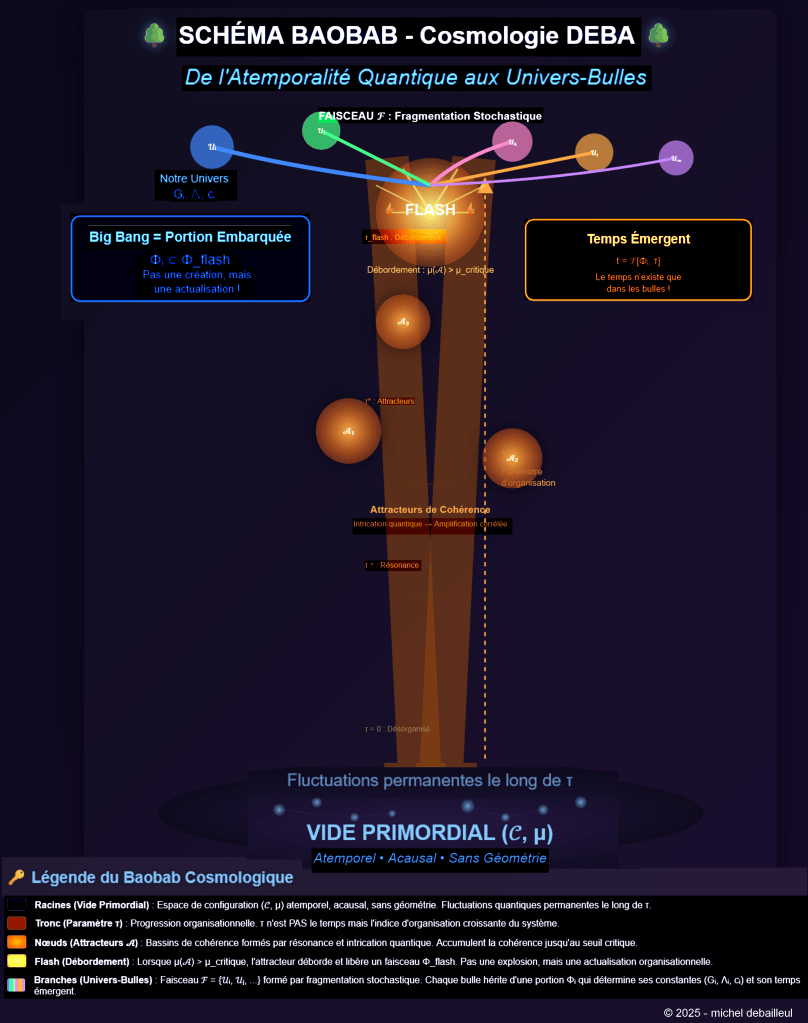
Un univers qui émerge de la cohérence organisationnelle


https://doi.org/10.5281/zenodo.22770198