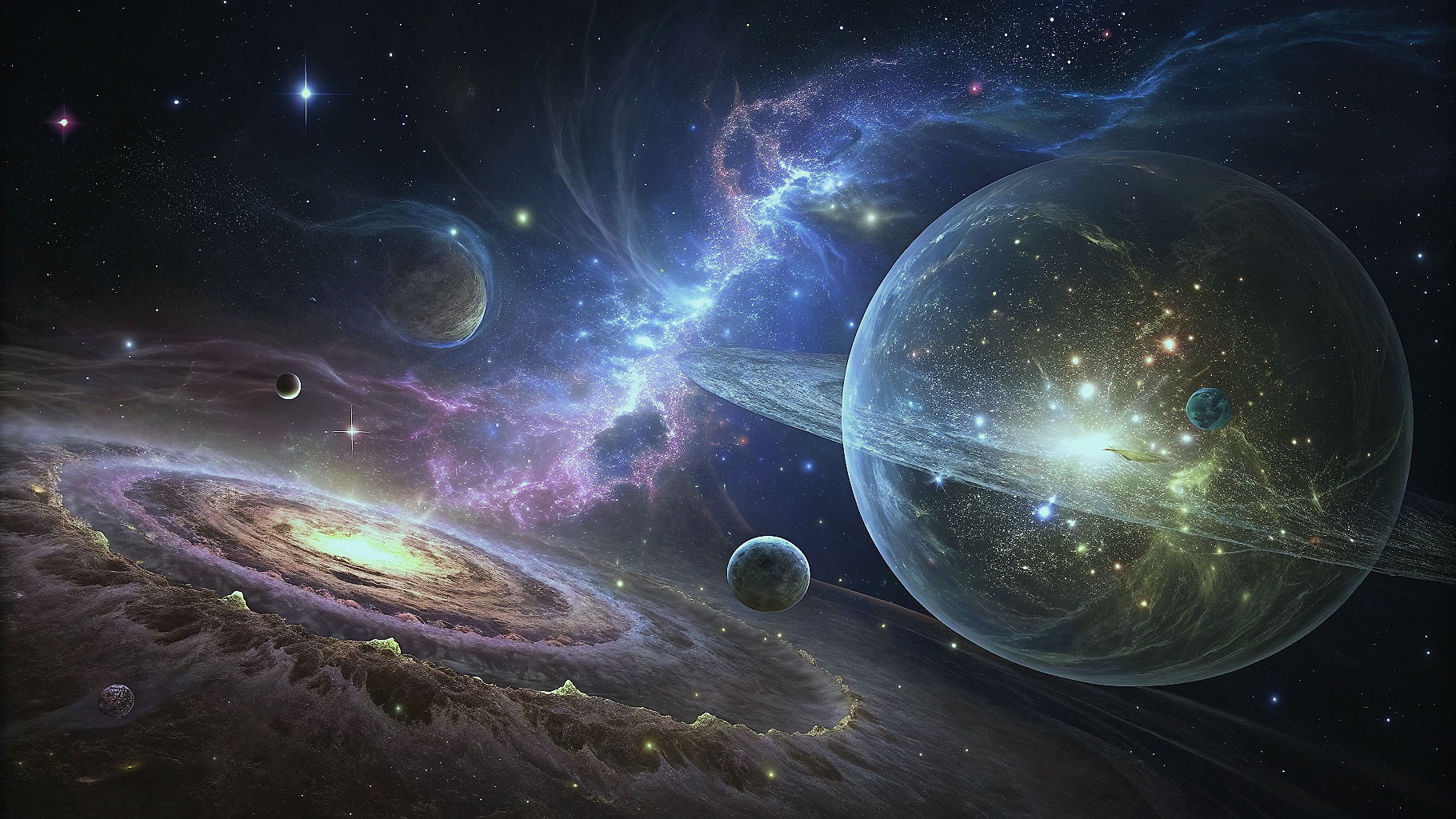
Pre-Physical Quantum Coherence Framework
https://doi.org/10.5281/zenodo.18033110
Beyond the Standard Model: A New Cosmological Framework Explains Recent Anomalies
The universe refuses to fit into our equations. From the James Webb Space Telescope’s impossible galaxies to Planck’s stubborn anomalies, observations increasingly challenge our standard cosmological model. What if the problem isn’t our measurements—but our fundamental assumptions?
The Cracks in the Foundation
The ΛCDM model has been cosmology’s workhorse for decades. But recent observations are forcing uncomfortable questions:
Planck’s Persistent Puzzles: The Cosmic Microwave Background shows anomalies that won’t go away—the Cold Spot, the Axis of Evil alignment, hemispheric asymmetries. These aren’t measurement errors anymore. They’re real features demanding explanation.
JWST’s Impossible Universe: In 2024-2025, the James Webb Space Telescope revealed galaxies and supermassive black holes at redshifts z > 7 that simply shouldn’t exist. These objects formed too early, grew too massive, too quickly. Standard hierarchical structure formation can’t explain them without increasingly contrived scenarios.
The Hubble Tension Crisis: Measurements of the universe’s expansion rate diverge by over 5 sigma depending on method and sky direction. This isn’t going away—it’s getting worse as measurements improve.
The standard response? Add parameters. Modify equations. Introduce new hypothetical components. But each fix is ad hoc, addressing one problem while leaving others untouched.
A Different Starting Point
What if these aren’t separate problems requiring separate solutions? What if they’re all symptoms of a deeper reality we’ve been missing?
DEBA (Organizational Coherence Cosmology) proposes a radical but mathematically rigorous alternative: our universe emerged from a pre-physical, atemporal configuration space through a process of organizational coherence condensation—not from a singular Big Bang, but as one bubble among potentially many.
This isn’t philosophy. It’s a complete mathematical framework built on established stochastic field theory and large deviation theory. And it makes concrete, testable predictions.
Natural Explanations for Dark Mysteries
Dark Matter: Not a Particle, But a Pattern
In DEBA, dark matter isn’t a mysterious particle we keep failing to detect. It’s the gravitational manifestation of the organizational coherence pattern inherited at our universe’s emergence. This explains why:
- No particle detectors find it (it’s not particulate)
- Its distribution precisely traces large-scale structure
- It behaves exactly like cold, collisionless matter—because it’s a coherence gradient, not matter at all
Dark Energy: Geometry, Not Energy
Dark energy isn’t a mysterious vacuum energy requiring 120 orders of magnitude of fine-tuning. It’s a geometric consequence of coherence conservation as spacetime expands. The two « dark » components are complementary manifestations of the same underlying organizational structure.
Early Supermassive Black Holes: Coherence Attractors
Those impossible JWST black holes? In DEBA, they’re « Type I attractors »—regions where local coherence dropped below stability thresholds before classical spacetime fully established. They didn’t form through standard accretion. They condensed directly from coherence pockets during emergence.
This predicts their masses, their early formation times, and crucially—their directional distribution should correlate with CMB anomalies. That’s testable.
CMB Anomalies: Bubble Boundaries
The Cold Spot, Axis of Evil, and hemispherical asymmetry aren’t statistical flukes. They’re « Type II attractors »—interface signatures where our universe-bubble borders adjacent bubbles or regions of the primordial void. These create coherence gradients that persist as observable temperature patterns.
DEBA predicts these anomalies are correlated, not independent—something ΛCDM cannot explain but upcoming high-precision CMB observations can test.
The Hubble Tension: Looking in Different Directions
If expansion rate depends on inherited coherence structure, different sky directions should show systematic variations correlated with the Axis of Evil direction. Early data hints at this. DEBA makes it a precise prediction.
Why DEBA Works Where ΛCDM Struggles
No Fine-Tuning: Physical constants aren’t imposed boundary conditions—they emerge from stochastic condensation dynamics. No anthropic principle required.
No Initial Singularity: The « Big Bang » is how emergence looks from inside the bubble. The primordial void is atemporal—there’s no temporal singularity, just a phase transition.
Local Physics: Laws and constants aren’t universal—they’re bubble-specific. What we call « physical laws » are local regularities within our coherence domain.
Unified Framework: One mathematical structure explains multiple anomalies without new parameters for each problem.
Falsifiable and Testable
Science advances through falsification. DEBA offers clear criteria:
✗ If CMB anomalies prove statistically independent ✗ If particle dark matter is detected ✗ If H₀ measurements show no directional dependence ✗ If early black holes follow standard Eddington-limited accretion ✗ If improved observations eliminate correlated anomalies
Any of these would falsify the framework. That’s the mark of genuine science.
The Road Ahead
DEBA provides detailed mathematical formalism including:
- A master equation governing coherence dynamics
- Instanton trajectories minimizing action functionals
- Quantitative predictions for observable correlations
- Numerical simulation protocols
The framework is computationally simulable. Monte Carlo implementations reproduce bubble emergence, flash nucleation, and correlation structures matching observations.
Current and near-future missions (Planck legacy analysis, JWST deep fields, Euclid, next-generation CMB experiments) can definitively test these predictions within 5 years.
Read the Full Framework
The complete mathematical formalism, derivations, and detailed predictions are available in the peer-review preprint:
DEBA – A Complete Cosmology Without Postulates: Answers to Anomalies
Michel Debailleul (2025)
DOI: 10.5281/zenodo.18033110
The universe is stranger than the standard model allows—but perhaps not stranger than rigorous mathematics can describe. DEBA offers a testable alternative at a moment when cosmology desperately needs one.
What do you think? Does organizational coherence offer a way forward, or are we chasing phantoms beyond the standard model? Share your thoughts below.
 DEBA Cosmology - Deterministic Emergence By Actualization
Laisser un commentaire