Michel Debailleul
Geophysicist
Université libre de Bruxelles (ULB)
ORCID: 0009-0003-1222-1433
michel.debailleul@yahoo.fr
May 3, 2026
© 2026 Michel Debailleul — CC BY‑NC 4.0 License
The origin of the Moon remains one of the major enigmas of planetary cosmogony.
This work proposes a mechanism based on the physics of threshold complex systems: the
formation of the Moon results from a triple phase transition within the fully molten proto‑Earth
undergoing progressive differentiation.
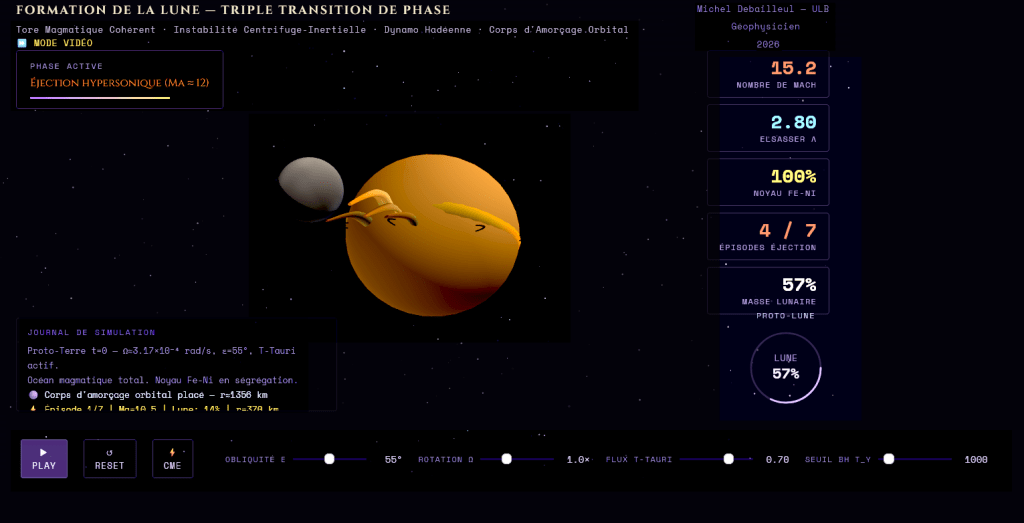
Complete video : https://github.com/Orion4622/DEBA-Cosmology © 2026 Michel Debailleul
The first transition is rheological:
The silicate magma obeys a Bingham‑Herschel (BH) law with a yield stress τy, which governs the cohesion of the intertropical Coherent Magmatic Torus (TMC, from the French Tore Magmatique Cohérent).
This TMC is of ’Aā nature: its biphasic structure — a mobile plastic core and a fragmented clinker crust — constitutes an intrinsic thermal insulator that maintains the torus coherence over the entire active window (≈ 60 Myr), without recourse to an external blanketing atmosphere.
The second transition is mechanical:
The kinetic energy accumulates in the TMC — a toroidal structure emerging in the oblique latitude band |φ| < 30◦ — until crossing a critical hypersonic ejection threshold (Ma ≈ 11.6), triggered by Mathieu resonance with the proto‑lunar tide.
The third transition is magnetic:
the terrestrial dynamo emerges progressively as Fe‑Ni segregation toward the
growing core surpasses the dynamo convection threshold, becoming detectable at ≈ 4.2 Ga
through the magnetization of Hadean zircons (Tarduno et al., 2025).
These three transitions are governed by a single driver: the progressive differentiation of iron
toward the core. This driver simultaneously controls the rheological evolution of the TMC,
the energy available for episodic ejections, and the growth of the core that powers the dynamo.
The T‑Tauri Sun, as an actively coupled actor, maintains the fully molten state, modulates the
effective Bingham threshold τy through its radiative flux, and provides impulsive perturbations
via coronal mass ejections (CMEs) that can trigger the first ejection episode. The temporal
coincidence between the T‑Tauri phase (∼ 4.55–4.50 Ga) and the proposed ejection window
(4.55–4.49 Ga) is causal, not accidental.
The capture of the ejected sheets by the Orbital Seeding Body (CAO, from the French Corps
d’Amorçage Orbital) is modeled as a process of non‑ballistic plastic accretion: the cohesive Bingham‑Herschel sheet loses its energy by viscoplastic dissipation within the sphere of
influence of the proto‑satellite, not by elastic collision of independent particles.
The capture fraction fcap is expressed by a closed analytical law coupling interception geometry and plastic capture number Πcap.
This episodic accretion produces a concentric internal lunar architecture in successive
layers: each sheet carries the geochemical imprint of the Earth’s mantle at the precise moment of its ejection, generating a radial Fe/Si gradient decreasing from the interior outward.
The current state of lunar seismological data is compatible with this stratification, without
confirming or refuting it.
The ongoing and forthcoming seismological missions — Farside Seismic Suite (FSS), Lunar Environment Monitoring Station (LEMS, Artemis III), and the international network under construction — offer the most direct observational framework to test this prediction, prior to and independently of any 3D numerical simulation.
The nominal rotation period is Trot = 3.5 h, consistent with planetary accretion simulations
(Agnor et al., 1999; Kokubo & Genda, 2010).
The stability coefficient λ is derived and discussed (Section 6.2) in the complete pdf (see the links)
Posture note. This work proposes a theory. All hypotheses are explicit. All limitations
are acknowledged. The observational and numerical validation programme is defined. Final
validation belongs to forthcoming lunar seismological data and, in a second stage, to 3D SPH
(Smoothed Particle Hydrodynamics) simulations.
For complete paper and complete video : https://github.com/Orion4622/DEBA-Cosmology
© 2026 Michel Debailleul — CC BY‑NC 4.0 License
 DEBA Cosmology - Deterministic Emergence By Actualization
Laisser un commentaire