
Version 4.0 — May 28, 2026 Submitted to Planetary Science Journal (AAS) — manuscript #AAS77321 Published on EarthArXiv — https://doi.org/10.31223/X5XB6H
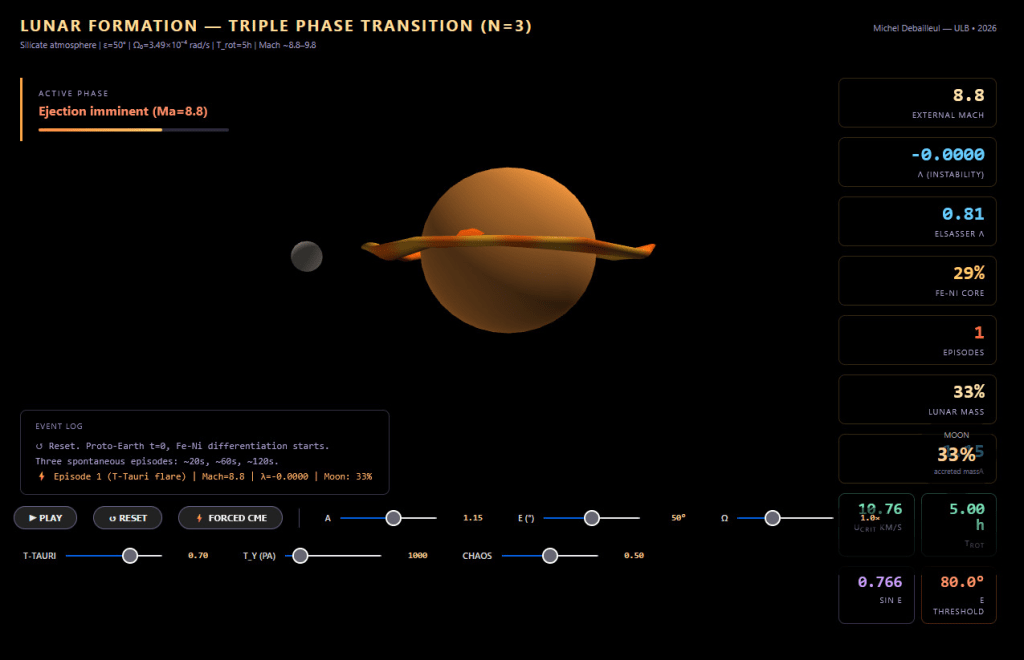
🔴 LAUNCH THE INTERACTIVE SIMULATION https://orion4622.github.io/moon-formation-triple-phase-transition/Animation_Formation_de_la_Lune_v2.html
What is the Triple Phase Transition?
The Moon did not form the way we thought. The canonical giant impact model (Theia) and the synestia model both fail to explain three fundamental observations: the near-isotopic identity of Earth and Moon, the crustal dichotomy, and the 300 Myr delay of the terrestrial dynamo.
The TPT proposes an entirely internal mechanism — no external impactor, no synestia, no free parameter — driven by progressive Fe-Ni segregation within a fully molten, rapidly rotating proto-Earth (T_rot ≈ 5 h).
The three coupled transitions:
① Rheological — Bingham-Herschel yield stress organises a Coherent Magmatic Torus in the Hadean intertropical belt of the co-rotating body frame
② Mechanical — elliptical parametric resonance (Malkus 1968; Kerswell 2002; Lacaze 2004) drives bifurcation velocity in ≈ 32 hours — no free parameter — 2–3 ejection episodes in 3–4 weeks
③ Magnetic — terrestrial dynamo delay 290–360 Myr, consistent with Jack Hills zircon data
10 falsifiable predictions — pre-registered before mission data
P1 — Seismic interface at 200–315 km depth — Chang’e 7, August 2026 P2 — Seismic asymmetry near side / far side — FSS + LEMS 2026–2030 P3 — Fe/Si gradient increasing with depth — Chang’e 6, Artemis III P3b — Fe enrichment at south pole — independent Lunar Prospector convergence P4 — Dynamo delay 290–360 Myr — Jack Hills zircons P5 — Instability window ε ∈ [57°, 70°] — N-body simulations P6 — Polar concentration of high-latitude ejecta — Chang’e 7 P7 — Hf-W age of episode 1: 4.467 Ga — Artemis III P8 — Formation age > 4.45 Ga — Artemis III P9 — Mare basalt source depth > 200 km — Apollo + Chang’e-5
Chang’e 7 — August 2026 — first verdict
All deposits and DOIs:
EarthArXiv (published): https://doi.org/10.31223/X5XB6H Zenodo V_4.0: https://doi.org/10.5281/zenodo.20426054 Zenodo (all versions): https://doi.org/10.5281/zenodo.20367218 OSF (pre-registered): https://doi.org/10.17605/OSF.IO/5DACG Figshare: https://doi.org/10.6084/m9.figshare.32306832 GitHub: https://github.com/Orion4622/moon-formation-triple-phase-transition Academia.edu: https://www.academia.edu/167890200
 DEBA Cosmology - Deterministc Emergence By Actualization